Saturday Evening Update

Saturday, January 24, 8PM

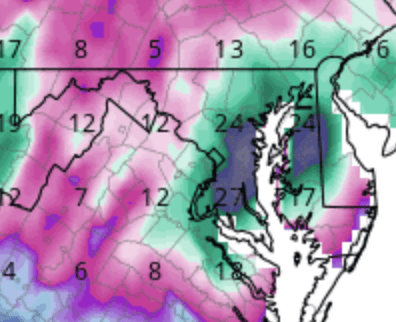
There’s still not model agreement on how long the cold hangs on before the flip to sleet in the morning, but regardless, this will be a high impact event through the day tomorrow, and probably for several days beyond. I don’t have anything to add to what I’ve already said. I am still thinking 6 – 9″ from the bay to just west of I-95 before a change to sleet. In the normally colder areas north of 70 and west of 32, I’m sticking with 8 – 14″ before a change. If the change happens earlier than late morning or early afternoon, then less snow and more frozen ball-bearings. Either way, tomorrow is a good day to stay off the roads.

If any surprises arise, I’ll update.

Saturday Morning Update

Saturday, January 24, 10AM

The arctic airmass has obviously arrived, and global models have come to some agreement, but the mesoscale models, which should be in range at this point, are concerning. They drive the primary low into the arctic mass to the west of us which brings a relatively warm layer aloft. So, although at the surface it’s well below freezing, snow falls from high altitudes, passes through a warm layer, melts to rain (or least no longer snow), then after passing through the warm layer, hits cold air and refreezes. If the cold layer at the surface is deep, the rain refreezes before hitting the ground as sleet. If the surface layer is shallow, the rain hits surfaces as a liquid and refreezes (freezing rain). Freezing rain is the most dangerous because it coats everything, including trees and power lines, with a heavy coating of ice. Sleet is terrible for roads and walkways, but it doesn’t stick to surfaces. Think ball-bearing ice pellets. It still is going to snow, but if the short range models are right, then the snow totals will be on the lighter end of the totals I’ve said the past couple of days. I’d be only guessing as to which scenario is correct, but the end result will still be extremely impactful.

In summary, snow develops around midnight, becoming heavy by morning with significant accumulations. I’m sticking with the totals from the past couple of days, but it depends on when the changeover occurs. After the change, there will be significant accumulation of sleet. In some areas it is going be really impressive. Hopefully we don’t get any freezing rain or drizzle because that would just make the glacier worse. I’ll update this evening with more details.

Finally, a reader asked a couple of questions and wanted my thoughts. First, they wanted to my opinion on when to start clearing a messy system like this. It’s a great question. Just my opinion, but for a storm like this, I would say to wait for all precipitation to end to start shoveling and clearing vehicles. Yes, it’s going to be much heavier, but getting under the fluffy snow is much easier than trying to get under ice. If it was going to be an all snow event, then I would say try to keep up, but with possibility of freezing rain, I am waiting. Also, we always read stories about heart attacks from shoveling, so go slow, and take breaks. You’re in no hurry as we are likely not going anywhere tomorrow or Monday.

The second question was about phone weather apps and why they show ridiculous snow totals. I never look at my iPhone app, but I just did and even now it say’s 20″ for tomorrow. That’s comical. I don’t know the algorithm that they use, but I suspect it is AI and obviously has no human input. I googled “why my phone app says high snow totals” and ironically, the AI response is pretty good, though there are a lot of human articles too. But here’s what AI wrote (the highlighting is not mine):

“Your phone’s weather app is likely showing high snow totals because 

it is pulling raw, automated data from a single computer model—often the American GFS model—without any human meteorologist to interpret or adjust the numbers. These models often over-calculate, particularly when they cannot accurately differentiate between heavy snow, rain, or a wintry mix. 

Here is a breakdown of why your app is showing high, and potentially inaccurate, snow totals:

  • Raw Model Output (No Human Touch): Apps often take direct, unedited output from computer simulations. Human meteorologists analyze multiple models and local factors to filter out these “fluke” high numbers, but apps generally just display the automated result.
  • The “10:1 Ratio” Fallacy: Many apps calculate snow by assuming 1 inch of rain equals 10 inches of snow. However, if the atmosphere is warmer or the snow is lighter, the ratio changes, and the app will significantly overestimate the total.
  • Wintry Mix Miscalculations: If the storm includes sleet, freezing rain, or rain, the computer model may mistakenly interpret this as heavy snow, leading to massive, inaccurate, and “eye-popping” numbers.
  • Model “Flip-Flopping”: Computer models often produce wildly different totals with every update (every 6 hours). The app may be showing a maximum potential model run rather than a likely scenario.
  • Timing of the Forecast: If the high number is for a storm several days away, it is highly likely to change as the storm gets closer and forecasters get more precise data. 

What to do instead:
For more accurate, localized, and context-driven forecasts, it is highly recommended to check with your local TV meteorologists or the National Weather Service. “

Friday Update

Friday, January 23, 12:30 PM

The global models have stopped the north bleeding since I last posted yesterday, and if anything, they are trending slightly south and with a colder profile. We are still too far out to rely heavily on the mesoscale (short range) models, and until the globals come to a consensus, I don’t see any reason to change much from yesterday’s post. In summary, the NWS has issued Winter Storm Warnings early this morning for all of MD west of the bay for Saturday night into Monday morning. Arctic air is arriving today and there are also Cold Weather Advisories for dangerous wind chills tonight through early next week. Regarding the storm, and this is still preliminary, but snow will develop from southwest to northeast across MD from 10PM to 1AM tomorrow night. The snow will initially be light but will pick up in intensity and be moderate to heavy by sunrise. Heavy snow will continue during the morning, but a warm layer will begin working in from the south and east, and snow will transition to a mix of snow and sleet, and even all sleet in many areas. It’s too early to know when that happens, but I still feel that 6-9″ of snow accumulation for areas along the bay to just west of I-95 respectively, before the changeover. For the normally colder western and northern counties west of Route 32 and north of I-70, 8 – 14″ of snow before any changeover, if at all. By Sunday evening, colder air will begin wrapping into the system’s higher levels and we will have to see if there is a changeover back to snow with additional accumulations. The accumulations that I stated are initial thoughts for what I think that accumulate before the changeover. We can save any talk about any possible additional snow accumulations Sunday night until tomorrow. Also, although the NWS defines sleet as snowfall, I am talking about just snow. Some areas are going to be measuring sleet in inches, so regardless of whether your area changes to sleet, this is going to be a very impactful storm well beyond Sunday. Sleet over snow with the frigid temperatures is going to make for a glacier. The good news is that right now freezing rain does not appear to be a major concern for most of central MD as the depth of the cold should be able to overcome a narrow warm layer. The exception is for readers in south and east areas including lower AA, Calvert, and especially St. Mary’s counties as icing could be substantial in some of those areas.

I’ll update later today if there are any substantial changes. If not, assume no changes, and I’ll send out something tomorrow morning. And finally, never trust snow accumulations on a phone’s weather app.

Thursday’s Update

Thursday, January 22, 1:30PM

Model trends haven’t been good for a pure snow event, but we are still on pace for a major winter storm. Though the surface is expected to be below freezing throughout central MD for the storm, models have brought in warmer air aloft that would bring sleet, and maybe a lot of it. If I had to make a guess now for central MD, snow begins around 10PM to midnight Saturday night and continues into Sunday. Around sunrise, the snow may be moderate to heavy. After that, it’s a matter of how far north and west the warm air aloft gets and how soon areas flip to sleet. An early guess would be the before the flip to sleet, about 6″ of snow along the bay to as much as 12″ in the colder northern and western areas of Baltimore and Carroll counties where the cold air should hold on longer. Right along the 95 corridor, anywhere from 6 – 9″. We might go into a dry slot during the late afternoon that might cut down on the amount of sleet or freezing rain, but regardless, all precipitation should wrap up by midnight. Again, this is all preliminary and things are certain to change.

Once the storm is over, all attention will turn to the all but guaranteed bitter cold that will be prevalent through the week. Whatever falls may turn to concrete and be around for the week. Additionally, models are suggesting another storm is possible the following weekend, so it seems winter may be here for an extended period. As far as I am concerned, it’s about time.

I’ll update as needed. Hopefully the models come to some solid agreement soon.

Weekend Update

Wednesday, January 21, 11AM

Yesterday at this time we were hoping that the storm wouldn’t be suppressed south, but model trends through yesterday afternoon and overnight has a lot of people wondering if this is going to end up too far north. I’m in the camp that we are going to see some big adjustments as the players come onto the playing field. The NWS stated in their discussion this morning that they will be sending recon flights over the Pacific where our southern energy is currently located, and that data from those missions will be ingested into tonight’s 0z model runs (midnight, our time). Additionally, the northern stream energy, specifically the arctic high that will be moving across the northern US during the event, is currently located in an area where data sampling is sparse. With that in mind, this will probably not be settled until late tomorrow or even Friday. But, we can still discuss what the models see at this point, but know that we are still early so expect changes.

Just about every model shows snow moving into the area Saturday night and continuing Sunday. The snow is moderate to heavy at times and they all show at least 8″ along the 95 corridor into early afternoon Sunday. They also show that surface temperatures stay well below freezing for all of central MD throughout the event. Where they differ is how much warm air is pulled in at the higher levels that could change the snow to sleet or possibly freezing rain. That is dependent upon how far north the primary low goes to our west as the storm transfers its energy to a coastal storm. The more north, the greater the chance of mixing. I am only guessing but the arctic high pressure to the north should be very strong so I don’t see it getting bullied as much as some models have shown. Not to mention, this is still a La Niña and the phasing and amplifying that we’re seeing right now on the models could be overdone. One other thing that is certain is that whatever falls, it won’t be going anywhere for awhile as temperatures next week look to be frigid for the duration.

I don’t like investing in any one model this far out, but I’m waiting for the midday GFS to run before posting, so for fun, here is what the morning AI EURO (6z) showed. Snow beginning around midnight Saturday/Sunday with a total of 10 – 12″ with temperatures never exceeding the mid 20’s. Some mixing in the afternoon on Sunday, but mainly south and east of 95. I only chose the AI Euro because it’s been fairly consistent from run to run so far.

Anyway the 12z GFS is done and it stopped the north bleeding and has snow starting late Saturday evening and going into Monday morning. Verbatim, there is no mixing issues for areas west of the bay, temperatures never get above about 20 degrees for duration and total accumulations are similar at 10 – 12″.

My takeaway from the runs this morning is that a major winter storm is likely across the mid-Atlantic on Sunday, but there are a lot of details to iron out. If the midday Euro and AIEuro show any drastic changes, I’ll do a brief update, otherwise I will probably wait until after the later evening model runs.

Early Thoughts for the Weekend

Tuesday, January 20, 10AM

There’s a long way to go, but every model is in agreement that a significant storm will traverse the southern US and impact the mid-Atlantic region some time this weekend. Obviously, the exact track will determine the amount and type of precipitation we see, and over the next several days you might hear some newer terms that forecasters will use in explaining the possibilities. I’ll try to briefly explain those terms below so we all know what the heck they’re talking about.

Frequent readers know that I often refer to the GFS, NAM, and EURO weather models. The GFS and NAM are American models and, as you likely surmised, the EURO is a European model. There are others of course, including Canadian, German, and British models, but most forecasters rely on the American and European models. Recently, however, there have been AI additions to these models. I don’t completely understand how they work, but the traditional models are physics based and use complicated equations to make forecasts. The new AI models use historical data and pattern recognition to make their forecasts. Again, I may sound like I know what I’m talking about, but saying it doesn’t mean I understand it. Regardless, it is a new tool to use in forecasting, especially because they have shown some surprising accuracy, especially the aieuro inside 4 or 5 days. Additionally, the sometimes crazy nam is due for retirement in March of this year and is being replaced by the Rapid Refresh Forecasting System (RRFS), which is already available to the public.

So, as we track this storm over the next 5 days, I’ll refer to the traditional GFS and EURO, but also the AIGFS and AIEURO. As we get closer to the event (hopefully), I’ll also refer to the short range or mesoscale models like the NAM and the new RRFS.

With all that being said, where do we presently stand for the weekend? As I said in a recent WM post, there is an abundance of cold air available and over the next few days, temperatures will modify a bit until a strong surge of arctic air comes in later in the work week. Initially, most models showed the cold air keeping the weekend storm suppressed to the south, which is still a possibility, but recent trends have brought the storm more north so that every model now has central MD getting into at least some of the action. The GFS has been the most south, but the early morning run has become more in line with its AI brother and brings about 4-6″ of cold powder late Saturday and Sunday. The axis of heaviest precipitation in both models is along the VA and NC border. Looking at the European suite, both EURO models also have the axis of heaviest precipitation to the south, but both bring more overall precip to our area. The EURO and AIEURO are slightly different in how the storm plays out, but in the end, they both say anywhere from 8 – 12″ of snow in central MD. How this eventually plays out is impossible to predict, but the overall trend has been coming north so although suppression is still a possibility, it is becoming less likely.

Frankly, I like where we stand right now. At four or five days out, I much prefer the storm being to our south than on top or north of us. There are still a lot of uncertainties but hopefully we can reel this in and get a much needed region-wide snow event. Finally, and not to get ahead of ourselves, but the pattern looks to continue into the foreseeable future.

I’ll update as needed.

Sunday Morning Changes?

Saturday, January 17, 11AM

Today was a nice surprise for those living about 10 miles north of I70. The NWS put out some late advisories for those areas this morning where a quick 1-2″ of snow fell making roads pretty dicey for a few hours in those areas. Things are starting to wind down from west to east, and any precipitation should be out of the area by early afternoon. Temperatures should be above freezing in all areas this afternoon, and there may even be some sun to help dry the roads.

That takes us to tomorrow where just yesterday I said that it looked to be a system that stays mainly to the east of central MD, but that may be changing. Short range models have brought the system further west to include the 95 corridor with snow moving in several hours before sunrise on Sunday and continuing into early afternoon. Temperatures again look marginal, so I am not expecting a lot of travel difficulty, but I’ll keep an eye on it and update this evening.

Beyond tomorrow, models continue to show more substantial possibilities for later next week and even the following week.

An Unsettled Weekend

Friday, January 16, 9:30AM

A predominantly northwesterly flow of Canadian air is setting up shop for the foreseeable future across the eastern US, so oscillating temperatures from slightly below to well below normal should be the rule going into next week. Unfortunately, the southern jet isn’t cooperating (yet?), so it will also be relatively dry. The exception is a couple of northern vortices presently diving down out of Canada that may or may not bring some snow to areas on Saturday and/or Sunday. Models are vastly different in how the weekend plays out, but the euro is suggesting a coating to as much as an inch in some northern areas tomorrow, while the gfs is passing on tomorrow’s piece of energy and focussing on another behind it for Sunday. The gfs enhances the second piece of energy early Sunday, but too late to impact central MD, suggesting that the eastern shore may have snow on Sunday. The euro says the gfs should lay off the hooch as the Sunday system stays offshore. My best guess is to cover all the bases and say that central MD may see some snow tomorrow with marginal temperatures that may accumulate on grassy surfaces, and the eastern shore may see some snow on Sunday that could make for some icy spots for a few hours. How’s that for a big, ‘I have no idea.”?

All models agree that after the weekend, the northwesterly flow continues to ebb and flow bringing a mix of bone-chilling to slightly below normal temperatures. The models are also in loose agreement that the southern jet becomes more active late next week into early February. That always brings the chance of the dreaded “cold and dry followed by warm and wet, repeat,” but with so much cold, Canadian air over us or just to our north, it wouldn’t take much to luck into a more sizable snowstorm. I have my fingers crossed that things get much busier here by the end of next week.

Changing Pattern

Saturday, January 10, 11AM

Although the Pacific continues to be in a La Niña, which typically doesn’t bode well for snow in these parts, there are some changes coming that might help our snow chances. A trough looks to set up over the eastern US next week, and that should help bring in more seasonable temperatures and possibly the opportunity for several snow chances over the next couple of weeks. Models are not in agreement for anything specific, but the first opportunity looks to be as soon as the second part of next work-week (Thursday’ish?). I am not expecting a big event, but even a modest snowfall would be welcomed.

I’ll update as needed.